


Basecamp and Asana are two of the most popular project management tools available today. Both offer a wide range of features designed to help teams collaborate and manage projects efficiently. However, they cater to slightly different audiences and use cases.
Basecamp is often preferred by small to medium-sized teams looking for a simple and intuitive platform. Asana, on the other hand, is favored by larger organizations and those needing advanced task management capabilities. Understanding their differences can help you choose the right tool for your specific needs.
Which should you choose?
Choose Basecamp if…
- You want a simple, straightforward tool.
- Your team is small or medium-sized.
- You prefer a flat-rate pricing model.
Choose Asana if…
- You need advanced task management features.
- Your team is large and requires robust integrations.
- You prioritize detailed reporting capabilities.
| Feature | Basecamp | Asana |
|---|---|---|
| Best for | Small to medium-sized teams | Medium to large teams |
| Learning curve | Simple, easy to learn | Moderate, more complex |
| Views | List, Calendar | List, Board, Calendar, Timeline |
| Automation | Basic to none | Advanced automation options |
| Integrations | Limited | Extensive integrations |
| Collaboration | Built-in chat and message boards | Comments, task assignments |
| Reporting | Basic | Advanced reporting and analytics |
| Plans | Flat-rate pricing | Tiered pricing plans |
| Support | Email support | Email and priority support |
Pros and cons
Basecamp
Pros
- User-friendly interface
- Flat-rate pricing
- Built-in communication tools
Cons
- Limited integrations
- Basic reporting features
- Lack of advanced automation
Asana
Pros
- Extensive integrations
- Advanced reporting and analytics
- Multiple view options
Cons
- Steeper learning curve
- Can be expensive for larger teams
- Overwhelming for small teams
Basecamp Overview
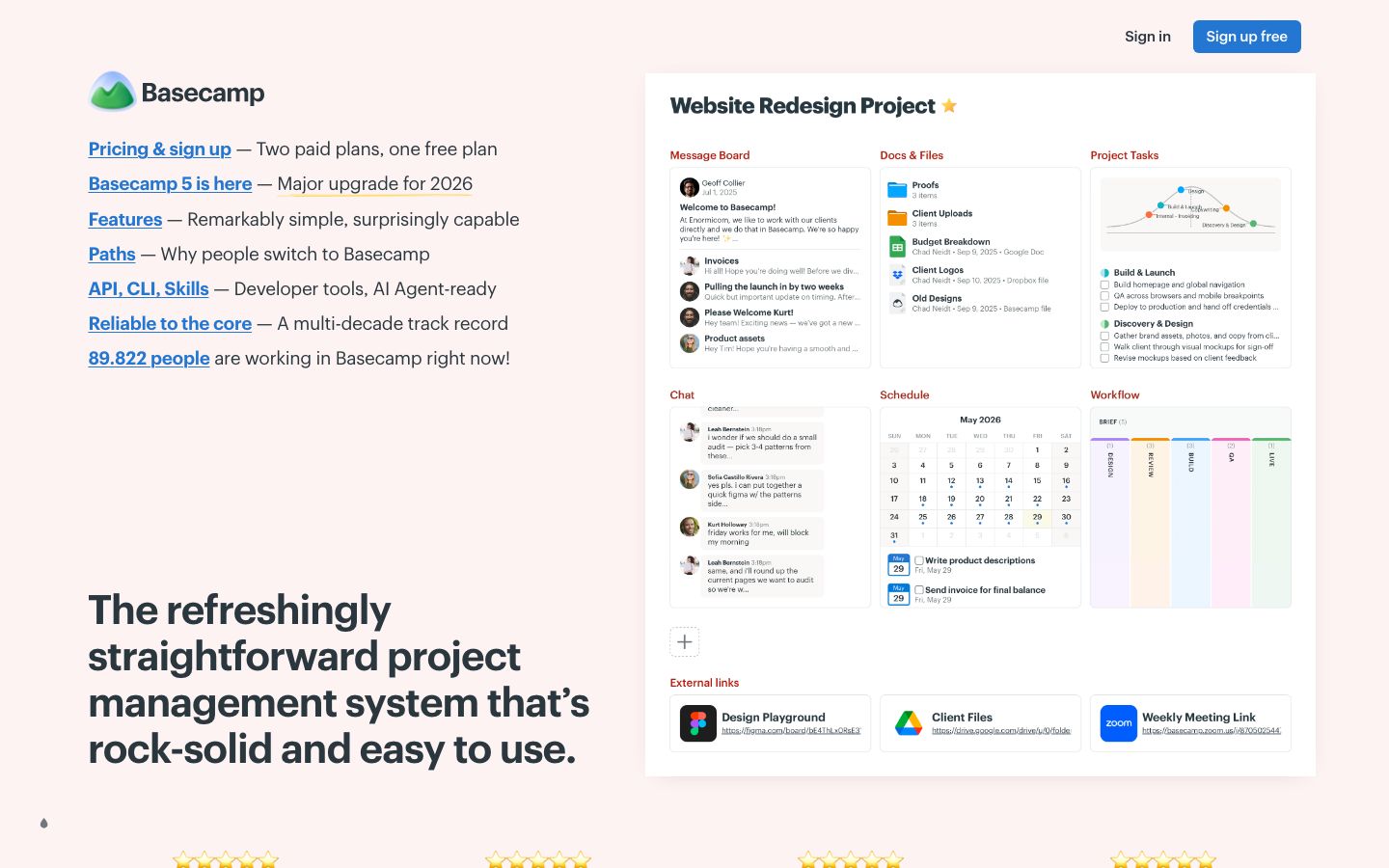
Basecamp is a project management tool designed with simplicity and ease of use in mind. It offers essential features that help teams stay organized, including to-do lists, file sharing, and scheduling tools. Its interface is intuitive, making it accessible for users with varying technical skills.
Basecamp's built-in communication tools, such as message boards and group chat, facilitate seamless collaboration among team members. It's particularly popular among small to medium-sized businesses that prioritize straightforward project management without the complexity of more advanced tools.
Asana Overview
Asana is a comprehensive project management platform known for its versatility and powerful task management capabilities. It supports multiple project views, including lists, boards, and timelines, allowing teams to manage tasks in the way that best suits their workflow.
Asana excels in offering advanced features such as automation rules and detailed reporting, making it a favorite among medium to large organizations that require a robust tool to handle complex projects. Its extensive integration options further extend its functionality by connecting with other business applications.
Key Differences
While both Basecamp and Asana aim to improve project management, they differ significantly in their approach and features. Basecamp focuses on simplicity, offering a user-friendly interface and essential tools for project management. It is ideal for teams seeking a straightforward solution without unnecessary complexity.
In contrast, Asana provides a more feature-rich experience with advanced task management, automation capabilities, and multiple project views. These features cater to teams that require a detailed and customizable project management tool to handle complex workflows.
Pricing Comparison
When it comes to pricing, Basecamp offers a flat-rate pricing model, which can be appealing for teams seeking predictable costs without worrying about per-user fees. This model is particularly beneficial for smaller teams or organizations with a tight budget.
Asana, however, uses a tiered pricing structure that scales with the number of users and features. While this can become costly for larger teams, it provides flexibility for businesses to choose a plan that matches their specific needs, offering more advanced features at higher tiers.
Ease of Use and Support
Basecamp is renowned for its ease of use, with an intuitive interface that requires little to no training. This makes it an attractive option for teams with limited time to onboard new tools. Support is primarily provided through email, which may be sufficient for most users.
Asana, meanwhile, has a moderate learning curve due to its extensive features. However, it supports users with comprehensive help resources and offers priority support at higher pricing tiers. This makes it suitable for teams that have the resources to invest time in learning the platform.
Which to Choose for Your Case
Choosing between Basecamp and Asana largely depends on your team's specific needs and priorities. If you are looking for a simple, cost-effective solution with built-in communication tools, Basecamp may be the right choice.
However, if your team requires robust task management, advanced automation, and detailed reporting, Asana might be the better fit. Consider the size of your team, the complexity of your projects, and your budget to make the best decision.
Verdict: Both Basecamp and Asana have their unique strengths. Basecamp is ideal for those seeking simplicity and fixed pricing, while Asana is better suited for teams needing advanced features and flexibility. Consider your team's needs and project complexity when choosing the right tool.
FAQ
Which tool is better for small teams?+
Basecamp is often preferred by small teams due to its simplicity and flat-rate pricing, making it easy to manage without extra costs.
Does Asana offer better automation features?+
Yes, Asana provides advanced automation options that allow users to create custom rules and automate repetitive tasks efficiently.
Can Basecamp integrate with other tools?+
Basecamp offers limited integrations compared to Asana, which provides extensive options to connect with other business applications.
Is Asana suitable for large organizations?+
Yes, Asana's robust features and scalability make it ideal for large organizations that need comprehensive project management capabilities.
What kind of support do these tools offer?+
Basecamp provides email support, while Asana offers email and priority support at higher pricing tiers, alongside comprehensive help resources.
How do the pricing models differ?+
Basecamp uses a flat-rate pricing model, while Asana offers a tiered pricing structure that varies based on features and team size.